28 days ago

Small Waves, World Champions: The Improbable Kingdom of Florida Surfing

Ask a surfer in Oahu or Santa Cruz what they think of Florida surf, and you'll likely get a polite smirk. No towering reef breaks. No thundering big-wave arenas. Just warm, shallow water rolling over sandbars, producing waves that rarely crack head-high. And yet, spin the globe of competitive surfing and Florida's fingerprints are everywhere — on world titles, on Olympic podiums, on the sport's entire evolution toward aerial, high-performance surfing.


This is the Florida Paradox: a state with some of the least intimidating waves in the world has produced some of its most dominant surfers. Kelly Slater, an 11-time World Champion, grew up carving the mushy peaks of Cocoa Beach. Caroline Marks, an Olympic gold medalist, cut her teeth in the same Space Coast waters. Lisa Andersen and C.J. Hobgood built legendary careers on Florida's unglamorous beach breaks. None of them learned on Pipeline. They learned on knee-high slop — and that, it turns out, is exactly the point.


Florida surfing isn't a lesser version of the sport practiced elsewhere. It's a different discipline entirely, one built on precision, adaptability, and relentless repetition. To understand how a flat, sandy peninsula became a factory for world champions, you have to understand the swells that shape it, the coastline that channels them, and the culture that turned limitation into innovation.

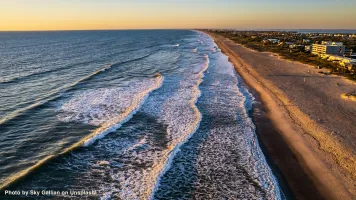
 An aerial view of Cocoa Beach and the surf at sunrise.. An aerial view of Cocoa Beach and the surf at sunrise..

Cocoa Beach Sunrise

Swell Science: How Hurricanes, Cold Fronts, and Sandbars Actually Work

Florida doesn't get waves from local wind chop alone — its best surf is imported, arriving as energy radiated from storms thousands of miles away. Understanding the state's three swell seasons is essential to understanding why the surf culture developed the way it did.


Hurricane season (August through November) is the holy grail. Tropical systems spinning off the African coast or churning in the mid-Atlantic generate long-period groundswell that fans out across open ocean and arrives on Florida's shores as clean, organized surf — provided the storm stays far enough offshore. When a hurricane or tropical storm tracks a few hundred miles east of the coastline, its outer bands never touch land, but the swell they generate keeps traveling, arriving days later as glassy, barreling waves under sunny skies. Locals call these "hurricane swells," and they're the closest thing Florida has to a guaranteed world-class session. The tradeoff is real danger: rip currents intensify, and surfers walk a constant line between chasing the swell of the year and respecting a storm that could turn deadly with little warning.


Winter cold fronts (December through March) bring a rawer, punchier energy. As nor'easters and Arctic fronts sweep down the Eastern Seaboard, they generate strong windswell — shorter-period, more chaotic waves that hit hard and close out quickly rather than peeling cleanly. Water temperatures drop into the 60s, sometimes the 50s in North Florida, and wetsuits become mandatory rather than optional. These fronts reward surfers who can read fast, sectioning waves and make split-second decisions, since the windows of quality are often brief and the waves less forgiving than their summer counterparts.


Summer (June through August) is the lull. The Atlantic goes quiet, tropical development hasn't ramped up yet, and Florida surfers are left with ankle-to-knee-high mush pushed around by sea breeze. Rather than a dead season, though, this became the state's incubator. Flat, weak summer surf is exactly where longboarding thrives, where kids learn to walk the nose, and where the fundamentals of footwork and wave-reading get hammered into muscle memory.


Layered underneath all three seasons is Florida's defining geographic feature: sandbars. Unlike the fixed reef and rock bottoms of Hawaii or California, Florida's seafloor is soft and mobile, reshaped by every swell, storm, and tide cycle. A sandbar that produced a perfect peeling wave last month might be a mushy close-out today, shifted fifty yards down the beach by a single tropical system. This constant flux means Florida surfers can never rely on memorized lineups — they have to read conditions fresh, every single session, at every single tide. That skill, more than anything else, is the hidden engine behind the state's competitive success.

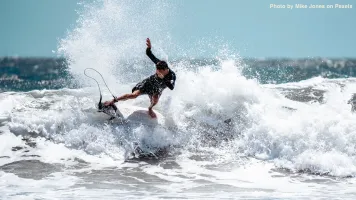
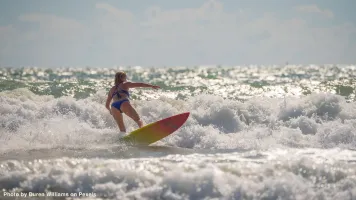
A woman rides the waves on a surfboard during a sunny day at the beach, capturing the essence of summer.A woman rides the waves on a surfboard during a sunny day at the beach, capturing the essence of summer.

The essence of summer.

The Regional Tour: From the First Coast to the Wildcards of the South

Florida's 800-plus miles of Atlantic and Gulf coastline aren't uniform — each region has its own character, shaped by its particular geography and history.


The Space and Treasure Coast is the heartbeat of Florida surfing. Cocoa Beach is where it all began, the spiritual capital of the state's surf culture. The Cocoa Beach Pier still anchors the town's identity, its wooden pilings framing decades of contests and casual sessions alike, while Ron Jon Surf Shop — an unmissable, neon-lit landmark just off A1A — has served as pilgrimage site and retail cathedral since the 1960s. This is longboard country, a place where mellow, rolling peaks reward patience and style over aggression, and where Kelly Slater first paddled out as a kid.


Just south, Sebastian Inlet flips that script entirely. Where Cocoa Beach is forgiving, Sebastian is a proving ground. The inlet's jetty channels and refracts incoming swell into First Peak, a wedge-shaped, fast, punchy wave that packs disproportionate power for its size. It's widely considered Florida's most high-performance wave, the kind of spot where surfers are forced to generate speed instantly and commit to steep, hollow sections. Sebastian Inlet State Park has produced an outsized share of Florida's professional surfers precisely because the wave offers no room for hesitation — you either adapt fast or you don't surf it well.


North Florida trades intensity for consistency. New Smyrna Beach is famously the most wave-consistent stretch of coastline in the state, picking up swell from more angles than almost anywhere else on the East Coast. It's also, notoriously, one of the shark-bite capitals of the world — a reputation earned from the sheer density of surfers, baitfish, and shallow water converging in the same stretch of ocean. Locals shrug it off as background noise; visitors tend to Google it obsessively beforehand. Further north, St. Augustine and the Jacksonville Beach Pier anchor historic, tight-knit surf towns where multigenerational local crews have surfed the same peaks since the sport's earliest days in Florida, sustaining a year-round community culture that predates the state's tourism boom.


South Florida and the Gulf Coast are the wildcards. Reef Road in Palm Beach is the rare South Florida break capable of holding real size, a rocky-bottomed anomaly that can turn into a genuinely heavy, powerful wave when a strong enough swell aligns — a startling contrast to the gentle beach breaks that dominate the region. South Beach in Miami and the Gulf Coast beaches around Tampa and the Panhandle are surf deserts most of the year, protected or too exposed in the wrong direction to catch consistent Atlantic groundswell. But when a severe cold front barrels through, or a tropical system tracks through the Gulf of Mexico, these normally flat stretches light up with novelty waves that draw crowds of surfers who might paddle out only a handful of times a year — a reminder that in Florida, even the driest zip codes get their moment.

The Breeding Ground: Why "Weak" Waves Produce World Champions

The idea that difficult waves make great surfers is intuitive. Massive, heavy, technical breaks like Pipeline or Teahupo'o seem like the obvious training ground for greatness. Florida's success complicates that assumption — and reveals something more interesting about what actually builds elite performance.


Small, mushy, short-period beach break waves are unforgiving in a completely different way. They don't offer the raw power to work with; a Florida wave gives a surfer maybe a second or two of usable face before it closes out or fades into whitewash. There's no free speed from a steep drop, no natural push from a heavy reef break. Every ounce of speed, every turn, every maneuver has to be manufactured by the surfer's own body — through pumping, weight transfer, and split-second footwork. Where a Hawaiian big-wave rider can let the ocean's power do the heavy lifting, a Florida surfer has to generate everything from scratch, over and over, on waves that are actively working against them.


This is precisely the training environment that produces technically flawless surfers. Riding weak, fast, closing-out sandbar waves for years builds an instinct for efficiency and improvisation that transfers remarkably well to any wave on Earth. A surfer who has learned to squeeze a full combination of turns out of a knee-high Sebastian Inlet close-out has developed a level of board control that translates instantly to bigger, more powerful waves elsewhere — the power is a bonus, not a crutch. It's telling that Florida-raised surfers have historically excelled specifically in the aerial and high-performance categories of competitive surfing, disciplines that reward exactly the kind of manufactured speed and technical precision that Florida's waves demand daily. If you can make something out of nothing on a mediocre Florida sandbar, a genuinely good wave anywhere else in the world starts to feel like a gift.

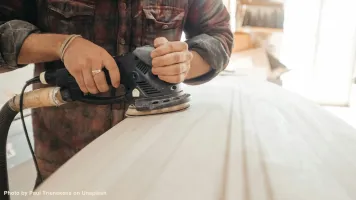
A surfboarder shaper working on a new surfboardA surfboarder shaper working on a new surfboard

Creating a new masterpiece, a board shaper at work.

Culture and Crafts: Shapers, Santas, and Lineup Etiquette

Florida's surf culture runs deeper than competitive results — it's embedded in garages, backyard shaping bays, and small-town traditions that have persisted for decades. The state has its own lineage of board builders and innovators, shapers who worked in relative obscurity compared to California's famous shaping houses but whose influence rippled outward regardless. Matt Kechele, a Florida surfer and shaper, became a pioneering figure in aerial surfing, helping push the maneuver from a novelty into a legitimate competitive weapon — a fitting contribution from a state whose waves practically demand that kind of airborne improvisation.


The culture shows up in its traditions, too, often with a wink. Every Christmas Eve, Cocoa Beach hosts Surfing Santas, a gathering that's grown from a handful of local surfers in red suits into thousands of participants paddling out in Santa hats, elf costumes, and full holiday regalia — a beloved, slightly absurd tradition that captures the region's laid-back sense of humor. The Easter Surfing Festival carries a similar spirit, blending contest heats with community celebration in a way that feels distinctly small-town rather than corporate.


Underneath the novelty events is a genuinely warm-water lifestyle. For most of the year, Florida surfers paddle out in boardshorts and bikinis rather than thick neoprene, and that accessibility has shaped the culture into something friendlier and more casual than the more territorial, cold-water scenes further north or out west. That said, friendliness has limits. Spots like Sebastian Inlet have deeply rooted local crews, surfers whose families have ridden First Peak for generations, and newcomers are expected to observe the unwritten rules: wait your turn, don't snake the inside position, and earn respect before expecting it.


Practical knowledge matters just as much as etiquette. Because Florida's sandbars shift constantly, the difference between an epic session and a wasted paddle-out often comes down to tide timing — a peak that's firing at low tide can turn into unrideable mush by high tide, and vice versa, sometimes within a single afternoon. Beyond wave quality, the ocean here carries real risks: stingrays buried in the shallows, sharks drawn by baitfish in places like New Smyrna, and rip currents strong enough to sweep even confident swimmers offshore. None of it is exotic or extreme by global standards, but it demands the same baseline respect any ocean deserves.

Silhouette of a surfer carrying a board at sunset on Melbourne Beach, Florida.Silhouette of a surfer carrying a board at sunset on Melbourne Beach, Florida.

Melbourne Beach, Florida

Conclusion: The Eternal Warm-Water Vibe

Florida will never have the raw power of Hawaii or the mythic reef breaks of Indonesia, and it doesn't need them. Its surf identity was built on something else entirely: sandbars that never sit still, swells imported from storms a thousand miles away, and a culture that turned mediocre waves into a masterclass in technique. Every World Tour trophy Kelly Slater lifted, every aerial Caroline Marks landed, traces back to countless unglamorous sessions on knee-high Space Coast peaks. That's the quiet lesson of Florida surfing — greatness doesn't require perfect waves, just the willingness to make something out of almost nothing, day after day, in board shorts, under a warm winter sun.

More Coastal Reads

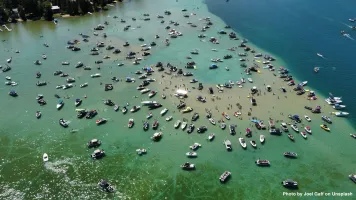
<p>Anchors Down, Coolers Up: Inside the Wild, Waterlogged World of Sandbar Parties</p><p>Anchors Down, Coolers Up: Inside the Wild, Waterlogged World of Sandbar Parties</p>

Anchors Down, Coolers Up: Inside the Wild, Waterlogged World of Sandbar Parties

There is a very specific sound that kicks off a great American weekend, and it is not a starting gun or a church bell. It is the low, satisfied rumble of a twin-engine center console idling out of a marina at 9:47 a.m., already three minutes behind schedule because somebody forgot the ice. Somewhere on board, a dry bag holds a bad speaker that's about to be asked to do the job of a great speaker. The cooler is packed like a Tetris champion did it. And out on the horizon, invisible but very much real, a shelf of sand is waiting just beneath the surface of the Gulf, the Atlantic, or the Bahama Banks — waiting to become, for one glorious afternoon, the most popular zip code in the state.


Welcome to sandbar season. Population: several hundred boats, a floating inflatable flamingo the size of a Buick, and at least one guy named Chad who brought a whole rotisserie chicken.

<p>The Florida Coastal Lifestyle: Where Every Day Feels Like a Getaway (Even Tuesdays)</p><p>The Florida Coastal Lifestyle: Where Every Day Feels Like a Getaway (Even Tuesdays)</p>

The Florida Coastal Lifestyle: Where Every Day Feels Like a Getaway (Even Tuesdays)

Close your eyes and picture it: bare feet on warm sand, salt in the air, a horizon that stretches on forever. Now open your eyes — because in Florida, that isn't a vacation fantasy. That's just Tuesday. Possibly a Tuesday where you also got a sunburn because you forgot, again, that the sun here does not mess around.


The Florida coastal lifestyle isn't a place — it's a whole personality shift. It's sunrise paddleboard sessions before your inbox is even awake, dockside dinners where the "catch of the day" was, at some point, actually swimming, and a general refusal to own a snow shovel ever again. So let's take a proper look at what makes coastal Florida living so irresistible — sunscreen not included.