
Coastal Reads

<p>The Florida Coastal Lifestyle: Where Every Day Feels Like a Getaway (Even Tuesdays)</p><p>The Florida Coastal Lifestyle: Where Every Day Feels Like a Getaway (Even Tuesdays)</p>

The Florida Coastal Lifestyle: Where Every Day Feels Like a Getaway (Even Tuesdays)

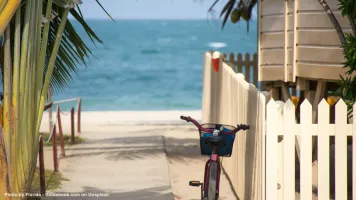
Close your eyes and picture it: bare feet on warm sand, salt in the air, a horizon that stretches on forever. Now open your eyes — because in Florida, that isn't a vacation fantasy. That's just Tuesday. Possibly a Tuesday where you also got a sunburn because you forgot, again, that the sun here does not mess around.


The Florida coastal lifestyle isn't a place — it's a whole personality shift. It's sunrise paddleboard sessions before your inbox is even awake, dockside dinners where the "catch of the day" was, at some point, actually swimming, and a general refusal to own a snow shovel ever again. So let's take a proper look at what makes coastal Florida living so irresistible — sunscreen not included.
<p>Small Waves, World Champions: The Improbable Kingdom of Florida Surfing</p><p>Small Waves, World Champions: The Improbable Kingdom of Florida Surfing</p>

Small Waves, World Champions: The Improbable Kingdom of Florida Surfing

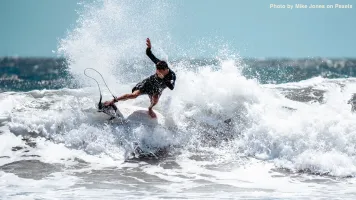
Ask a surfer in Oahu or Santa Cruz what they think of Florida surf, and you'll likely get a polite smirk. No towering reef breaks. No thundering big-wave arenas. Just warm, shallow water rolling over sandbars, producing waves that rarely crack head-high. And yet, spin the globe of competitive surfing and Florida's fingerprints are everywhere — on world titles, on Olympic podiums, on the sport's entire evolution toward aerial, high-performance surfing.


This is the Florida Paradox: a state with some of the least intimidating waves in the world has produced some of its most dominant surfers. Kelly Slater, an 11-time World Champion, grew up carving the mushy peaks of Cocoa Beach. Caroline Marks, an Olympic gold medalist, cut her teeth in the same Space Coast waters. Lisa Andersen and C.J. Hobgood built legendary careers on Florida's unglamorous beach breaks. None of them learned on Pipeline. They learned on knee-high slop — and that, it turns out, is exactly the point.


Florida surfing isn't a lesser version of the sport practiced elsewhere. It's a different discipline entirely, one built on precision, adaptability, and relentless repetition. To understand how a flat, sandy peninsula became a factory for world champions, you have to understand the swells that shape it, the coastline that channels them, and the culture that turned limitation into innovation.

<p>Anchors Down, Coolers Up: Inside the Wild, Waterlogged World of Sandbar Parties</p><p>Anchors Down, Coolers Up: Inside the Wild, Waterlogged World of Sandbar Parties</p>

Anchors Down, Coolers Up: Inside the Wild, Waterlogged World of Sandbar Parties

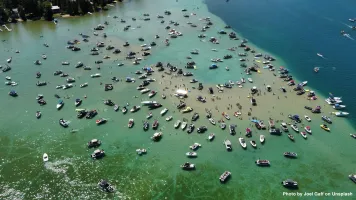
There is a very specific sound that kicks off a great American weekend, and it is not a starting gun or a church bell. It is the low, satisfied rumble of a twin-engine center console idling out of a marina at 9:47 a.m., already three minutes behind schedule because somebody forgot the ice. Somewhere on board, a dry bag holds a bad speaker that's about to be asked to do the job of a great speaker. The cooler is packed like a Tetris champion did it. And out on the horizon, invisible but very much real, a shelf of sand is waiting just beneath the surface of the Gulf, the Atlantic, or the Bahama Banks — waiting to become, for one glorious afternoon, the most popular zip code in the state.


Welcome to sandbar season. Population: several hundred boats, a floating inflatable flamingo the size of a Buick, and at least one guy named Chad who brought a whole rotisserie chicken.